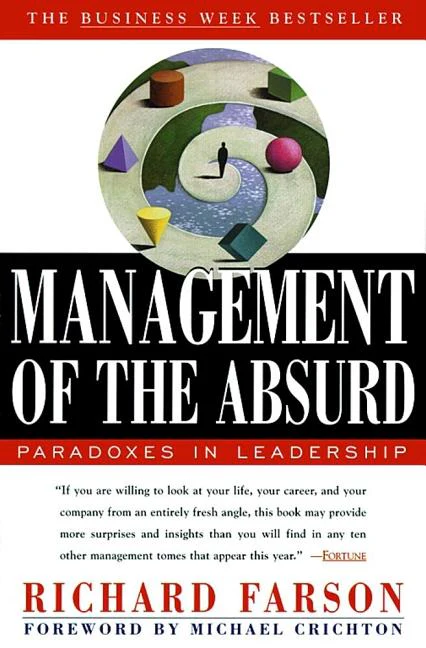
Management of the Absurd
Facile formulas, catchy slogans, ten-step programs, and quick fixes too often dominate today's management training programs. But in organizations as in all of life, human behavior is seldom predictable, and business dilemmas do not easily lend themselves to gimmicks or simplistic answers. In "Management of the Absurd, " psychologist, educator, and former CEO Richard Farson presents a series of management paradoxes designed to challenge conventional wisdom and encourage managers to reexamine their assumptions about effective leadership.
Here, at last, is a dramatically new understanding of organizations and human relations. In his explorations of more than 30 paradoxical situations, Farson demonstrates the value of a radically different perspective on leadership and offers managers powerful new ways to cope with the many perplexing problems of organizational life. Managers at every level will recognize the very real dilemmas and complexities that Farson describes, and will be challenged by these provocative new views of the art of managing people.
Here are some of Farson's startling insights:
The better things are, the worse they feel.
Once you find a management technique that works, give it up.
Big changes are easier to make than small ones.
The more we communicate, the less we communicate.
Nothing is as invisible as the obvious.
Effective managers are not in control.
Organizations that need help most will benefit least from that help.
Many readers will share Michael Crichton's response to this book, as he observes in the foreword, "He irritated me. He provoked me. He made me nod, he made me smile, and he made me shake myhead....[He] reports more than experience; he gives us wisdom." Guided by "Management of the Absurd, " managers of the 21st century will be able to accept the inherent complexity of management situations and work through these dilemmas, not with manipulative and simplistic techniques but with understanding, compassion, and effectiveness.
Here, at last, is a dramatically new understanding of organizations and human relations. In his explorations of more than 30 paradoxical situations, Farson demonstrates the value of a radically different perspective on leadership and offers managers powerful new ways to cope with the many perplexing problems of organizational life. Managers at every level will recognize the very real dilemmas and complexities that Farson describes, and will be challenged by these provocative new views of the art of managing people.
Here are some of Farson's startling insights:
The better things are, the worse they feel.
Once you find a management technique that works, give it up.
Big changes are easier to make than small ones.
The more we communicate, the less we communicate.
Nothing is as invisible as the obvious.
Effective managers are not in control.
Organizations that need help most will benefit least from that help.
Many readers will share Michael Crichton's response to this book, as he observes in the foreword, "He irritated me. He provoked me. He made me nod, he made me smile, and he made me shake myhead....[He] reports more than experience; he gives us wisdom." Guided by "Management of the Absurd, " managers of the 21st century will be able to accept the inherent complexity of management situations and work through these dilemmas, not with manipulative and simplistic techniques but with understanding, compassion, and effectiveness.
$14.00
Management of the Absurd—
$14.00
Product Information
Product Information
Shipping & Returns
Shipping & Returns
Description
Facile formulas, catchy slogans, ten-step programs, and quick fixes too often dominate today's management training programs. But in organizations as in all of life, human behavior is seldom predictable, and business dilemmas do not easily lend themselves to gimmicks or simplistic answers. In "Management of the Absurd, " psychologist, educator, and former CEO Richard Farson presents a series of management paradoxes designed to challenge conventional wisdom and encourage managers to reexamine their assumptions about effective leadership.
Here, at last, is a dramatically new understanding of organizations and human relations. In his explorations of more than 30 paradoxical situations, Farson demonstrates the value of a radically different perspective on leadership and offers managers powerful new ways to cope with the many perplexing problems of organizational life. Managers at every level will recognize the very real dilemmas and complexities that Farson describes, and will be challenged by these provocative new views of the art of managing people.
Here are some of Farson's startling insights:
The better things are, the worse they feel.
Once you find a management technique that works, give it up.
Big changes are easier to make than small ones.
The more we communicate, the less we communicate.
Nothing is as invisible as the obvious.
Effective managers are not in control.
Organizations that need help most will benefit least from that help.
Many readers will share Michael Crichton's response to this book, as he observes in the foreword, "He irritated me. He provoked me. He made me nod, he made me smile, and he made me shake myhead....[He] reports more than experience; he gives us wisdom." Guided by "Management of the Absurd, " managers of the 21st century will be able to accept the inherent complexity of management situations and work through these dilemmas, not with manipulative and simplistic techniques but with understanding, compassion, and effectiveness.
Here, at last, is a dramatically new understanding of organizations and human relations. In his explorations of more than 30 paradoxical situations, Farson demonstrates the value of a radically different perspective on leadership and offers managers powerful new ways to cope with the many perplexing problems of organizational life. Managers at every level will recognize the very real dilemmas and complexities that Farson describes, and will be challenged by these provocative new views of the art of managing people.
Here are some of Farson's startling insights:
The better things are, the worse they feel.
Once you find a management technique that works, give it up.
Big changes are easier to make than small ones.
The more we communicate, the less we communicate.
Nothing is as invisible as the obvious.
Effective managers are not in control.
Organizations that need help most will benefit least from that help.
Many readers will share Michael Crichton's response to this book, as he observes in the foreword, "He irritated me. He provoked me. He made me nod, he made me smile, and he made me shake myhead....[He] reports more than experience; he gives us wisdom." Guided by "Management of the Absurd, " managers of the 21st century will be able to accept the inherent complexity of management situations and work through these dilemmas, not with manipulative and simplistic techniques but with understanding, compassion, and effectiveness.